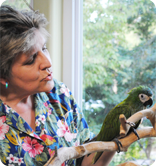



Parrot Blogger - Evet Loewen

– About Evet –
Evet regards her experiences with Orthopsittica manilata as part of an extended education in avian conservation and parrot welfare, and is sharing it here.

Read more »


Subscribe to this blog

RSS feed »
atom feed »


What is this?

April 24 2013

Red Bellied Macaw Chronicles Part 6: Feather Studies

by Evet Loewen

Of any of my birds, the Red Bellied Macaws have always drawn the greatest interest from their caretakers and the treating veterinarians and staff. It is their subtle and elegant appearance that first attracts people to them. As one gets to know them, it is their amiable nature, sans the drama of other small macaws and conures, which draws people into their orbit.

image


Red Bellied Macaws have a distinctive yellow facial patch that was described as "heart-shaped" by staff at For the Birds. That facial patch is a dark yellow for older birds and for birds that get the appropriate amount of sunshine (more on that to come). The featheration over the head, neck and chest is opalescent with hints of turquoise and blues amidst the general light lime green cast. Hints of a brown tone appear on the back and secondaries mixed in with the greens.

image
Chest feathers below lower mandible (male)


image
Belly feathers below crop (female)


The leading edge of the wings finds more blue than green, again with an iridescent quality. The underside of the wings brings in translucent yellow green featheration, with elongated narrow feathers. All featheration seems very understated compared to my "high-contrast" Illiger's.

There really seems to be very little of a red-belly on this species - more of a small patch of burgundy in the vent area. The physiology of the species from head to tail is very trim, with the tail feathers tapering to an elongated narrowed "V". Round dark brown eyes, black beak and legs and talons set apart the opalescent, nearly translucent featheration.

They are handsome. They are not raucous. Though I have one who is pretty silly sometimes, silliness hasn't seemed to be their modus operandi.

Since this avian species, like all others, evolved to fill an environmental niche, and developed their featheration and colors and behaviors in order to survive and thrive in the wild, it is hopelessly anthropomorphic for me to equate their appearance with my perception of their behavior. However, so far I've not been censored on this blog, so I'll say this: the subtleties of their featheration match their understated (compared to other macaws) personalities. They just aren’t "in-your-face" kinda psittacines. Mine have been gentle souls. Not that they won’t give you a good bite if they have to. But they typically prefer not.

image
Four feathers from Marco (captive bred) on left, and four feathers from Jake (wild caught) on right


--------
To Follow: Part 7-- Observing Sophia and Flock Integration

Posted by Evet Loewen on 04/24 at 10:07 AM
Comments (0) Comments


April 10 2013

Red Bellied Macaw Chronicles Part 5:  Sophia (aka ‘Jake’) Gets Her Health Check

by Evet Loewen

image


The acquisition of my severe macaw, Pepper, had taught me the importance of getting an avian veterinarian to check any new birds to be introduced into the flock at the earliest possible time. So, at least I was educable in that sphere!

By the year 2000, my avian veterinary clinic was For the Birds, now located in San Jose, California. Dr. Fern Van Sant, DVM had taken over as the principal avian veterinarian for the flock from her associate, Dr. Hilary Stern, DVM. Both of them are excellent, knowledgeable, and caring about avians and their human clientele. They are thorough in their exams, and I came to simply accept their standards as the template. For the Birds has been a practice devoted 100% to extraordinary avian care for many years.

Even with my confidence in For the Birds, I decided to seek Sophia's first wellness exam from a third avian veterinarian in the San Francisco Bay Area, also with an excellent background for avian care, and with some experience with Red Bellied Macaws. Not many avian veterinarians had experience with the species, and I thought it important that Sophia be seen by one who did.

It was a week into May before I took Sophia for her wellness exam. It was also her first time being transported in a car with me. She had not settled in to the rest of the flock yet, and I thought it would be a rough ride for her.

Instead she was intensely curious, not making an anxious sound at all and looking all around at the scenery as we drove. Perhaps the drive gave visual stimulation, like flight, I thought.

As far as I could tell, the medical exam went extremely well. Sophia's featheration was pronounced excellent. A second DNA test was run to verify gender, and again came back that macaw was indeed female. A CBC was returned as normal, as was a fecal culture. No lesions or papillomas in the choana or cloaca. I frankly did not know what to look and listen for regarding the health status of this bird and so simply heard the term "nice bird" or "beautiful featheration". The one type of bloodwork not done at this time was for uric acid levels, and I did not understand the significance of that bloodwork until many months later.

With the wellness exam over and the indications positive, I didn't see a need to do anything further with regard to her health. I could begin to oversee her integration into the flock.

Over time, I learned that assuming knowledge that is really outside one's expertise is a dangerous thing; a little knowledge is a dangerous thing; the equivalent of nearly no knowledge is also perilous. It's a very fine line to walk with any avian species, and also with veterinarians.

The easy proclivity of the Red Bellied Macaws to gout and kidney disease was well-known even at the time Sophia came to me. Being knowledgeable enough to request bloodwork on uric acid levels would have been the right way to be. I didn't understand the need for UA bloodwork on this species, and I didn't take Sophia in to For the Birds for a workup. I think I just told the staff at my regular clinic that everything was cool, and assumed it was.

I was in essence a bird-owner-in-training. Over several years, I found the best relationship to have with any avian veterinarian treating my flock is a collaborative one, where either party could ask questions of the other and neither one would become defensive in giving the answer. Honesty was definitely the best policy even if it were slow in coming.

Case in point. At Dr. Van Sant's office, the veterinary technicians on a well bird exam would come out to inspect whatever parrot that was brought in and peer into the carrier to take an initial look-see at the bird and whatever else happened to be in the carrier. A brief report of that look-see would be given to Dr. Van Sant before the owner came into the exam room. A brief comment would then be made during the exam of the dangers of sunflower and safflower seeds, or peanuts, or the soft cotton rope toy given to keep that bird semi-entertained in the carrier and more likely to simply be pooped on.

So, did I stop giving the birds sunflower or safflower seeds, or peanuts, or cotton ropes? Noooo. I did diligently remove these items from the carriers prior to taking birds in to see Dr. Van Sant, however. That way, it became a case of "see no evil" on the part of the vet tech, and "hear no evil" on my part. Wasn't too hot for the bird, though. Dr. Van Sant does have a good sense of humor and really laughed out loud when I finally confessed to this ruse.

As a lawyer, I'm inclined to investigate facts for clients and ask questions. However, all along the way with my birds, I've not asked all the questions that could have been asked. The birds have all had to teach me about their needs. It's a tough job, but some bird has gotta do it.

And they all have. Whether they wanted to, or not.

Next up: Red Bellied Macaw Chronicles Part 6 - Feather Studies

Posted by Evet Loewen on 04/10 at 07:48 AM
Comments (0) Comments


March 08 2013

Red Bellied Macaw Chronicles Part 4: Jake

by Evet Loewen

The First Red Bellied Macaw is the Best, Until One Gets the Next One or Two, That Is

Orthopsittica manilata
were uncommon in 2000, eight years after the Wild Bird Conservation Act of 1992 was in effect. Howard Voren's article on the difficulties of formulating a diet for this species was on the web then, and still is today. That was virtually the only information I had at the time concerning the differences in diet and temperament for this species in comparison to other parrots and especially in comparison to my other mini-macaws.

Manilatas have been notoriously hard to keep in captivity. Ignorance for most humans does indeed still constitute bliss, however. I am sorry to say that I am no exception to this rule.

P.A.S.[1] was in full swing the Spring of the year 2000. I began an extensive internet search for Red Bellied Macaws for sale. There were very few leads on the internet, and I was diligently searching for any mention on lists of parrot breeders, listservs, and such print media as had classified ads by aviculturists.

Then, on some listserv pertaining to macaws, a participant named Michell mentioned that she had a Red Bellied Macaw. One thing led to another – I emailed Michell to inquire about her bird. She replied that she had just sold the Red Bellied Macaw (named "Jake") back to the lady from whom she had purchased him, whose name was Judi. I was advised to contact Judi directly, and promptly did so. "Jake" was still with Judi, and was available for sale.

Michell had thought Jake to be a very neat bird. She indicated that he liked to spend time in her kitchen, on the top of the refrigerator as I recall. He seemed to have some freedom inside the house. There was some family complication that made it not possible to keep Jake, although Michell was clearly charmed by him.

The back story to "Jake" is a bit fuzzy. Michell thought that Jake was handraised and was only two years old, and was a male. Judi indicated that this red bellied macaw was a wild-caught, with an open band, had been DNA tested as a female, and the age was not really clear. It didn't matter. He/she was a Red Bellied Macaw, the first I could locate, and that was that.

Ancient emails indicate that a first contact with Michell occurred on April 13th, 2000. By April 27th, a deal had been struck with Judi and "Jake" was shipped from Minneapolis Airport to San Jose California arriving at 1:43 PM. I was instructed to look at him/her before I left the cargo area – the health paper was on top of the carrier and her DNA paper was to be mailed to me.

Everyone knows not to purchase a bird sight-unseen, right? All ya'll reading this blog post know that, right? It didn't matter. Here was a Red Bellied Macaw. The first search had been successful.

"Jake" arrived in a state of high anxiety, it seemed to me. Red bellied macaws have a high pitched voice and make continual nearly staccato "beeps" when anxious. At least, that is my analysis of the sounds I've heard mine make. They are known to be stress-prone, tautly- strung birds. He/she was inside of a wired, specially made cage that itself was placed in a carrier, and very securely put together so as to prevent an escape. It must have seemed very claustrophobic to a bird, a creature of light and air.

Releasing "Jake" from the carrier and the interior cage was not easy (and not intended to be). Disassembling the carrier and taking pliers to the wired cage were necessary. When freedom finally arrived, this bird burst out of the carrier cage while crying loudly, and definitely looked straight at me with alarm and fear. I felt extreme concern for this beautiful bird who seemed so glad to be out of that enclosure, and at the same time, so frightened of me.

As quickly as I could manage, "Jake" was taken to his new cage located in a room with sunshine and an open window, set up with water and food, and then was left alone. I couldn't resist looking in on him frequently, but in general I understood that this bird needed time to adjust and as much quiet as could be managed in a house with other parrots and an open floor plan.

"Jake" was my first "wild caught" parrot. It was only 8 years since the importation of exotic birds had been banned in the US, so obtaining a wild-caught bird was not uncommon. Since then, there have been three other wild-caught parrots of different species that I have cared for. This Red Bellied Macaw seemed different from my captive-bred parrots in two particular ways: he did not want to be held; and he was notably more responsive and attentive to what requests I made of him, as long as I gave him plenty of physical space. As much space as I could give a creature of light and air who was now inside my small house, with hardly an outdoor patio for fresh air and sunshine.

Believing in matters of science (DNA testing) and in the certificate I received from Judi, "Jake" was thus renamed "Sophia". Of course, it didn't matter to Sophia what human name I gave her. I thought her to be a beautiful bird, and Sophia to be a beautiful name, so that's the name she received, based on the gender I then believed her to be.

Next up in Part 5: Sophia (aka Jake) Gets a Health Check

---------------------
1 Parrot Acquisition Syndrome – See Red Bellied Macaw Chronicles Part 3

image


Posted by Evet Loewen on 03/08 at 03:37 PM
Comments (0) Comments


November 19 2012

Red Bellied Macaw Chronicles Part 3

by Evet Loewen

Why Acquire Multiple Small Macaws When One Doesn’t Understand the FIRST Small Macaw One Gets?

image


It’s been a while since I’ve contributed here because I’ve been trying to figure out how I decided to acquire a bunch of mini-macaws, including Red-Bellied Macaws. This is a difficult topic, the one of owning several birds. Like, more than ten, and less than fifty. In my defense, a lot fewer than fifty, but a squidge more than ten.

From 1998 to 2005, I acquired sixteen small macaws. The species included one Chestnut-Fronted Macaw, one Yellow-Collar Macaw, three Red-Shouldered (Hahn’s) Macaws, six Blue-Winged Macaws (Illiger’s), and eventually five Red-Bellied Macaws.

Of this group, prior owners gave me two of the Red-Shouldered Macaws and the Yellow-Collar. My first Red-Bellied Macaw, an older wild-caught, was only with me for less than two years and died of visceral gout. An Illiger’s and a Red-Bellied Macaw, both young, were lost due to the mistaken belief that they would not leave my shoulder if I stepped outside, and were not retrieved alive. One lucky Illiger’s who needed his own space was happily re-homed with good friends. The rest still take a disproportionate amount of my time and treasure, but reside contentedly now in their own secure private aviary facility built especially for them.

The small macaws were and remain a favorite.[1] They are feisty, raucous, and handsome. They like music, good food, and remind me in a very favorable way of living in Brasil. Of course, they themselves, were they in their native habitat, would occupy parts of Brasil.

If I could tell you a logical reason for starting a collection of birds, it would have been written weeks ago and would be incisive. Taking birds willingly surrendered from prior owners doesn’t feel so odd. As to ones obtained without such a compelling rationale, there is no simple, direct, logical reason that I myself understand for maintaining such a persistent preoccupation with small parrots. All I know is that by the year 2000, P.A.S. (Parrot Acquisition Syndrome) was in full swing, and it seemed totally fine to consider having an entire flock of small macaws, with the possible representation of every small macaw species available.

What I can proffer as to my attraction to small macaws (and parrots in general) is the following:
  • Parrots stop time. They live a long time and for large blocks of time they do not change much physically. It is jarring to look at records indicating their ages and years they’ve been with me, because they age so much better than I do.

  • Be Here Now. That’s what they require. It’s a form of meditation to spend time with lots of birds. Turn aside your anxiety or the parrot will mirror it. Don’t yell or the parrot mimics it. Don’t enter their space, wherever that is, in a state of high stress, or your hearing will pay the price for it.

  • Biology rules. It does with us though we forget that. It certainly does with these practically wild flighted creatures. They search for cavities in closets, engage in foraging on floors, under towels and any other intriguing space, find bonded others in two-legged featherless and flightless beings, engage in calling loudly to their flock or bonded other by use of calls-expecting-responses, or human language, as a few examples.

  • Continuous improvement is mandatory. Especially on dietary matters. We don’t always know what they evolved to eat, but they didn’t all evolve to eat the very same foods (or seeds). They don’t do well unless the biped caring for them starts to get educated about their nutritional needs. Which knowledge sometimes helps the biped, too.

  • Smaller beaks (than the large macaws) are more user-friendly. This is especially good for people with hang-ups about step-up training or who are easily intimidated by small green bossy parrots, let alone the large colorful or pure white ones.

  • Small macaws have No Hidden Agendas. This is applicable to most parrots and probably all kinds of species other than Homo sapiens. WYSIWYG (old techie term for “What You See Is What You Get”).

  • Mini-macaws minimize materialism. To live with parrots and small macaws is to learn that the objects one prizes are unimportant. Because one has to choose between the mini-macaw that grabs, with talons and/or beak, the watch or ring or earring or blouse or picture frame or molding or chandelier, and destroys it within three seconds, and the feeling of frustration derived from the destruction of the item(s). Over time, material things just have not meant as much as the living, breathing, feathered and flighted dinosaur descendants that occupy time and space with me.

So I guess the general attraction is that these small macaws inspire lessons in appreciating the moment, understanding biology, learning about evolution and its effects on nutrition, overcoming fear of physical pain, putting living creatures (humans included) at a higher priority than stuff, and being authentic. Very Zen, no?

Other than as in the old potato chip ad that “you can’t have just one”, I can’t articulate a good reason for setting out to get a bunch of small macaws -- only that I did do so. And that the Red-Bellied Macaws have presented me with the greatest challenge in keeping them here on the planet with me, in terms of their health and well being.

Parting thought. Once I was interviewed for a possible story by a reporter for the Wall Street Journal who wanted to know why Peregrine falcons were so fascinating to me. This because of the role I played in a prior life, with an educational project about bringing this species back from extinction. I said that Peregrine falcons are spectacular in flight, extraordinarily beautiful, wonderful in raising young. This very nice young lady pressed and pressed, and none of the statements I made seemed adequate for her purposes. Finally I simply said “I don’t know why they draw me in. Why do people play golf?” [2]

Why indeed.

So next post (Part 4), the specifics of my Red-Bellied Macaws come to the foreground.

---------
[1] We will not be discussing the dilemma of acquiring or listing other non-mini-macaw species in our parrot count.
[2] This response elicited much laughter from the interviewer but no article in the WSJ.

image


Posted by Evet Loewen on 11/19 at 09:05 AM
Comments (0) Comments


Page 1 of 2 pages  1 2 >