



Blue-backed Parrot |
|
|
Also known as: Mueller's Parrot
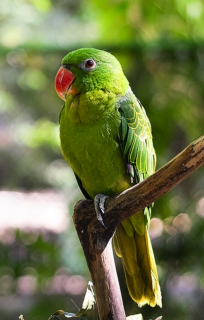
Blue-backed Parrot
© Chris [CC BY 2.0] via Wikimedia Commons
Photos
View in GalleryAcademic Research
Related publications: Tanygnathus everettiSpecies Profile
Genus: Tanygnathus | Species: everetti
Size:
32 cm (12.5 in)
Weight:
230-330 g (8-11.5 oz)
Subspecies including nominate:
Four: T.s. everetti, T.s. burbidgii, T.s. duponti, T.s. freeri
Colour Adult:
T.s. everetti: Both adults-as in burbidgii but head darker green; mantle edged dark blue; rump and lower back darker blue. Eye red.
T.s. burbidgii: Both adults-deep blue rump and lower back.
T.s. duponti: Both adults-as in everetti but more yellow neck in a noticeable collar.
T.s. freeri: Both adults-as in everetti but more yellow in general; paler blue on mantle.
Colour Juvenile:
As in adult.
Call:
Likely similar to Azure-rumped Parrot: calls described as loud and barking; also disyllabic call followed by upslurred, nasal screeching note; musical quavering shriek and single, nasal-sounding squawk. While perched gives single loud notes.
More Information:
Content Sources:
Blue-backed Parrot
© Chris [CC BY 2.0] via Wikimedia Commons
Photos
View in GalleryAcademic Research
Related publications: Tanygnathus everettiSpecies Care
Captive Status:
Not found.
Longevity:
Not recorded.
Housing:
Not recorded.
Diet:
Not recorded.
Enrichment:
Not recorded.
Nest Box Size:
Not recorded.
Clutch Size:
Not recorded.
Incubation Time:
Not recorded.
Fledging Age:
Not recorded.
Hatch Weight:
Not recorded.
Peak Weight:
Not recorded.
Weaning Weight:
Not recorded.
Blue-backed Parrot
© Chris [CC BY 2.0] via Wikimedia Commons
Photos
View in GalleryAcademic Research
Related publications: Tanygnathus everettiSpecies Wild Status
World Population:
375-1500
IUCN Red List Status:
Endangered
CITES Listing:
Appendix II
Threat Summary:
Has a restricted range. Possibly now extinct on Negros and Siquijor, and very rare on Mindoro, Luzon and other islands due to a combination of habitat loss and heavy illegal trapping. The reported scarcity of birds in markets suggests the genuine rarity of the species. Mining activities are reducing habitats across Tawi-Tawi.
Range:
T.s. everetti: Central to southern Philippine Islands.
T.s. burbidgii: Sulu Archipelago, southern Philippine Islands.
T.s. duponti: Luzon, northern Philippine Islands.
T.s. freeri: Polillo, northern Philippine Islands.
Habitat:
Thought to be similar to Azure-rumped Parrot: tropical, lowland, and montane forests, as well as mangrove swamps and degraded forests
Wild Diet:
Thought to be similar to Azure-rumped Parrot: may include fruits of Leptospermum and Ficus, nuts, seeds and berries and occasionally cultivated crops.
Ecology and Behaviour:
Very little known of ecology but thought to be similar to Azure-rumped Parrot: Resident, quiet and inconspicuous. Mostly encountered singly, in pairs or less often in small flocks.
Clutch and Egg Size:
Likely 2-3 eggs.
Breeding Season:
Possibly April. Nest is likely in tree hollow.
Related Links:
Blue-backed Parrot
© Chris [CC BY 2.0] via Wikimedia Commons
Photos
View in GalleryAcademic Research
Related publications: Tanygnathus everettiMembers Only Resources
Please log-in now to find more research, resources and tools.
Not a Member?
Find more great information:
Gain exclusive access to 600+ pages of additional research, seminars and podcasts, specialists to ask your toughest questions, and dozens of other fun resources - when you become a WPT member.
Join Today >>
Already a Member?
Encyclopedia