



Green-rumped Parrotlet |
|
|
Also known as: Blue-winged Parrotlet, Common Parrotlet, Guiana Parrotlet (F.p. passerinus)
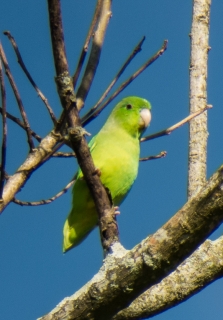
Wild Green-rumped Parrotlet
© Len Blumin [CC BY-NC-ND 2.0] via Flickr
Photos
View in GalleryDid You Know?
Despite their small size, parrotlets should never be kept with other parrot types in the same cage. This is due to the aggressiveness of the male parrotlet.Academic Research
Related publications: Forpus passerinusSpecies Profile
Genus: Forpus | Species: passerinus
Size:
12cm (4.7 in)
Weight:
20-28g (0.7-1.0 oz)
Subspecies including nominate:
five: F.p. passerinus, F.p. viridissimus, F.p. cyanophanes, F.p. cyanochlorus, F.p. deliciosus
Colour Adult:
F.p. passerinus: Male-lower back to upper tail coverts green, grey wash on nape and hindneck; secondary coverts pale blue; outer secondary feathers and inner primary coverts purple/blue; underwing coverts purple/blue tipped with green. Bill pink/horn coloured. Eye brown. Female-green markings instead of blue.
F.p. viridissimus: Male-darker green body; secondary feathers and secondary coverts darker blue; underwing coverts and axillary feathers blue/green with purple/blue patch on lesser underwing coverts. Female-as in passerinus.
F.p. cyanophanes: Male-as in viridissimus, but more extensive purple/blue on primary and secondary coverts forming obvious patch on closed wing. Female-as in passerinus.
F.p. cyanochlorus: Male-as in passerinus, but darker purple/blue on lesser underwing coverts. Female-more yellow/green than passerinus.
F.p. deliciosus: Male-lower back and rump emerald green washed pale blue; primary and secondary coverts pale blue with violet/blue along shafts of feathers. Female-as in passerinus, but with yellow wash on forehead.
Colour Juvenile:
As in adults.
Call:
Calls in flight said to be shrill cheet-it…cheet-it or chee-sup….chee-sup. Also loud chattering notes while in flocks and more penetrating sounds.
Listen NowVideo Links:
Video 1 | Video 2 | Video 3More Information:
Content Sources:
CITES
BirdLife International
Cornell Lab of Ornithology/Birds of the World
Parrots: A Guide to Parrots of the World, Juniper and Parr, 1998
ML Media Collection Catalogue 64385, Green-rumped Parrotlet Forpus passerinus, Schwartz, Paul, Aragua, Venezuela, Feb. 27 1973, Cornell Lab of Ornithology. Site
Parrots of the World, Forshaw and Cooper, 1977. 2010 edition
Lexicon of Parrots, Thomas Arndt.
Parrots of the World, Forshaw, 2006.
Wild Green-rumped Parrotlet
© Len Blumin [CC BY-NC-ND 2.0] via Flickr
Photos
View in GalleryDid You Know?
Despite their small size, parrotlets should never be kept with other parrot types in the same cage. This is due to the aggressiveness of the male parrotlet.Academic Research
Related publications: Forpus passerinusSpecies Care
Captive Status:
Becoming more common.
Longevity:
Up to 25 yrs.
Housing:
Outdoor or indoor enclosure, minimum length 1.2m (4 ft).
Diet:
Pelleted diet, supplemented with calcium (via cuttlebone or drops); fruits such as: apple, pear, orange, banana, kiwi, pomegranate, etc; vegetables such as: carrot, corn, celery, peas in the pod, green beans and green leaves; seed mix including: millet, safflower, buckwheat, oats and limited sunflower; millet spray; seed grasses where available.
Enrichment:
Bathing, socialization, swings, ropes, bird-safe chew toys (with pine or fir wood, or vegetable tanned leather), puzzle toys, foraging items.
Nest Box Size:
Vertical box, 6" x 6" x 6" (15cm x 15cm x 15cm).
Clutch Size:
5 or 6
Incubation Time:
20-22 days
Fledging Age:
5 weeks
Hatch Weight:
Not recorded.
Peak Weight:
Not recorded.
Weaning Weight:
Not recorded.
Wild Green-rumped Parrotlet
© Len Blumin [CC BY-NC-ND 2.0] via Flickr
Photos
View in GalleryDid You Know?
Despite their small size, parrotlets should never be kept with other parrot types in the same cage. This is due to the aggressiveness of the male parrotlet.Academic Research
Related publications: Forpus passerinusSpecies Wild Status
World Population:
Unknown, decreasing.
IUCN Red List Status:
Least Concern
CITES Listing:
Appendix II
Threat Summary:
Generally common and possibly increasing with forest clearance within its range. Appears to have colonised Trinidad and is spreading on Tobago where recently introduced. However, it is heavily trapped for local and other trade.
Range:
F.p. passerinus: Guianas, also introduced unsuccessfully to Martinique, West Indies.
F.p. viridissimus: Trinidad, N Venezuela and NE Colombia. Introduced to Curacao, Netherland Antilles; also Tobago and possibly to Jamaica and Barbados.
F.p. cyanophanes: N Colombia.
F.p. cyanochlorus: Upper Rio Branco, Roraima, N Brazil.
F.p. deliciosus: N Brazil.
Habitat:
Found up to 1800m (5904 ft) in open to semi-open habitats, including dry scrubland, deciduous woodland, gallery forest near water, farmland and other cultivation with scattered trees and urban parks or gardens.
Wild Diet:
Small grass seeds including Croton hirtus, Hyptis suaveolens, Wissadula, Cyperus, Scoparia dulcis and Melochia parviflora, obtained by settling on grass stems and allowing weight to bend seedhead to ground. Also berries including mistletoe, fruits such as Anona and Psidium guajava, leaf buds, blossoms and seeds of Lagerstroemia indica and sunflowers.
Ecology and Behaviour:
Gregarious, forming flocks of up to 100 birds at one time in communal roosts or feeding areas outside of breeding season. About half of wild females attempt second brood in breeding season.
Clutch and Egg Size:
5 or 6 sperical to elliptical eggs, 17.5 x 14.4mm. (0.7 x 0.5 in).
Breeding Season:
Most of the year depending on location. Nest is in hollow stump, limb, trunk or arboreal termitarium. Also more rarely palm frond base and man-made piping.
Related Links:
Wikipedia
Research: Contact calls are used for individual mate recognition in free-ranging Green-rumped Parrotlets
Wild Green-rumped Parrotlet
© Len Blumin [CC BY-NC-ND 2.0] via Flickr
Photos
View in GalleryDid You Know?
Despite their small size, parrotlets should never be kept with other parrot types in the same cage. This is due to the aggressiveness of the male parrotlet.Academic Research
Related publications: Forpus passerinusMembers Only Resources
Please log-in now to find more research, resources and tools.
Not a Member?
Find more great information:
Gain exclusive access to 600+ pages of additional research, seminars and podcasts, specialists to ask your toughest questions, and dozens of other fun resources - when you become a WPT member.
Join Today >>
Already a Member?
Encyclopedia