



Rainbow Lorikeet |
|
|
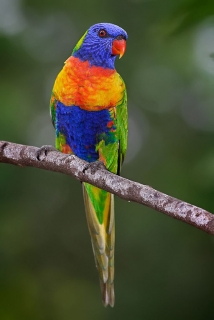
Rainbow Lorikeet
© User:Fir0002 [GFDL 1.2] via Wikimedia Commons
Photos
View in GalleryAcademic Research
Related publications: Trichoglossus moluccanusSpecies Profile
Genus: Trichoglossus | Species: moluccanus
Size:
26cm (10 in)
Weight:
100-157g (3.5-5.5 oz)
Subspecies including nominate:
two: T.m. moluccanus, T.m. septentrionalis
Colour Adult:
T.m. moluccanus: Both adults strong purple/blue streaking on entire head; yellow/orange breast with barring minimal or absent; collar yellow/green; deep purple/blue abdomen.
T.m. septentrionalis: Both adults as in moluccanus, but purple/blue streaking on head brighter; shorter tail.
Colour Juvenile:
As in adults.
Call:
Repeated notes, sharp, rolling while in flight. Shrill chattering while feeding. Soft notes at rest.
Video Links:
Video 1More Information:
Content Sources:
Rainbow Lorikeet
© User:Fir0002 [GFDL 1.2] via Wikimedia Commons
Photos
View in GalleryAcademic Research
Related publications: Trichoglossus moluccanusSpecies Care
Captive Status:
Less common.
Longevity:
20 years in the wild, 15-25 years captivity.
Housing:
Enclosure with drain in floor, or suspended cage over tiled or concrete floor.
Diet:
Nectar - a commercial type specially formulated for small species or a mix of baby cereal (lactose-free) and honey, malt extract or molasses, mixed with filtered water, made fresh once or twice daily, making up at least 40 percent of the diet; vegetables and fruit especially apple, pear, orange, cactus fruits and bananas, and one or more daily of: carrot, fresh corn, green leaves; plus dried figs soaked in water for a few hours, spray millet and a small amount of soaked or sprouted sunflower seed and small amount of canary seed.
Enrichment:
Loves bathing, hanging toys, puzzle/foraging toys, foot toys, ladders, swings, socializing; noisy toys (bells, squeakers), bird safe chewables (vegetable tanned leather, safe woods).
Nest Box Size:
L-shaped box, 51cm x 36cm (20 x 14 in).
Clutch Size:
2 to 3
Incubation Time:
23-25 days
Fledging Age:
8-9 weeks
Hatch Weight:
5g (0.2 oz)
Peak Weight:
Not recorded.
Weaning Weight:
Not recorded.
Rainbow Lorikeet
© User:Fir0002 [GFDL 1.2] via Wikimedia Commons
Photos
View in GalleryAcademic Research
Related publications: Trichoglossus moluccanusSpecies Wild Status
World Population:
Unknown, decreasing.
IUCN Red List Status:
Least Concern
CITES Listing:
Appendix II
Threat Summary:
Not globally threatened. Population is in decline due to heavy international trade. Abundant in NE Australia, however, a recent decline has been seen on Cape York Peninsula. Is becoming less numerous in the southeast; was once common in Victoria and now relatively rare. Increasing around Melbourne, Sydney and Canberra. Moderately common in S Australia and rare in Tasmania. Has become established in Perth and Auckland, NZ.
Range:
T.m. moluccanus: Occurs in SE and E Australia from Gulf of Carpentaria and S Cape York Peninsula, N Queensland, south to S Victoria and SE South Australia, including Kangaroo Island; also Tasmania and introduced to Perth district, SW Australia.
T.m. septentrionalis: Found N Queensland, on islands in Torres Strait, excluding Boigu and Saibai; also Cape York Peninsula south to Endeavour and Daintree Rivers.
Habitat:
Most common in lowlands but found up to 2400m (7872 ft). Wide variety of areas including settlements, forest, coconut plantations, savanna, Eucalypt stands and mangroves.
Wild Diet:
Diet includes nectar and pollen from native trees and shrubs such as Eucalyptus gummifera, E. maculata, E. tereticornis; also Pittosporum, Grevillea, Spathodea, Metroxylon, Schefflera, Pterocymbium, Erythrina, Banksia, Melaleuca, Angophora, Bauhinia, Cocos coconut (of which this species is an important pollinator), Xanthorrhoea, Bombax, Verticordia, Bletharocarya, Myrtaceae bottlebrush and Loranthaceae mistletoes. Also fruit of Ficus, Trema, Mutingia, Schefflera actinophylla, citrus, papaya and mangoes; seeds of Cassia and Casuarina, pupae of the poinciana moth Pericyma cruegeri, psyllid-infested leaves of Eucalyptus melliodora, sap of E. resinifera and flowers of Archontophoenix cunninghamiana, Schefflera actinophylla and Platanus orientalis. Also takes introduced fruits and seeds including Sorghum, seeds of Solanum, ripening cones of Pinus, fruit of Annona and Cinnamomum, berries of Schinus, apples and pears. Also observed to eat at base of ant-plants Myrmecodion.
Ecology and Behaviour:
Found in mixed flocks with other parrots; in small noisy groups. Nomadic, as they are dependent on flowering trees. Roosts communally in groups of hundreds of birds. Will also roost and nest on the ground on some of the predator-free islands. Displays frequently.
Clutch and Egg Size:
2 to 3 ovate eggs, 27.0 x 22.5mm (1 x 0.9 in).
Breeding Season:
August–January, SE Australia, may be almost year-round in Queensland. Nest is in deep unlined limb or tree trunk cavity.
Rainbow Lorikeet
© User:Fir0002 [GFDL 1.2] via Wikimedia Commons
Photos
View in GalleryAcademic Research
Related publications: Trichoglossus moluccanusMembers Only Resources
Please log-in now to find more research, resources and tools.
Not a Member?
Find more great information:
Gain exclusive access to 600+ pages of additional research, seminars and podcasts, specialists to ask your toughest questions, and dozens of other fun resources - when you become a WPT member.
Join Today >>
Already a Member?
Encyclopedia