



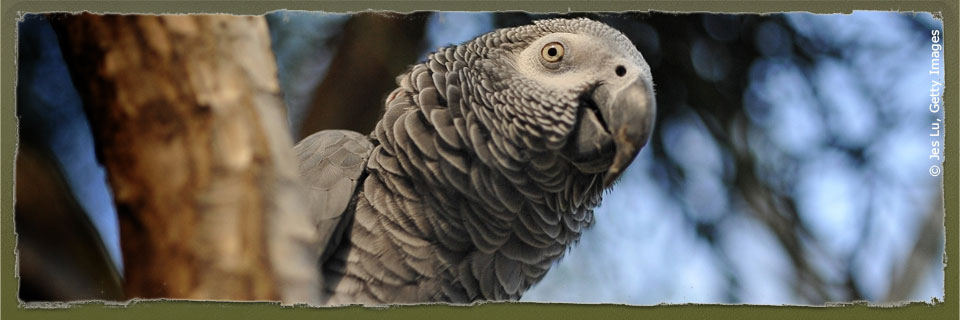




Hello, My name is Heidy. I am living in the Netherlands. There is something on my mind for quite a long time and I still don't know what to do. In February 2010 we bought our female Congo African Grey Sammy. For me it was love at first sight. Sammy and I have a wonderful relationship. At least I think so. Right from the start I was sure I wanted to buy another parrot because I wanted to have some bird company for Sammy.
So in May of 2010 we were at the same parrot shop where we bought our Sammy. The owner had some young Meyers parrots. We decided not to buy one of them right away but to think it over for a couple of days. In the car on our way home we decided against it. A few days later however, after done a bit of reading, we decided to buy one of the Meyers parrot after all. Right at their first encounter Buddhi (the Meyers parrot) attacked Sammy. They dislike each other ever since. And to be quite honest I myself have a bit of a love/hate relationship towards Buddhi. On the one hand I think she is a cute little parrot (she likes to crawl very much) but on the other hand I don't really like her (although she has grown on me) and I think made a mistake buying her. I never imagined and was never told that there was such a big difference in character between an African Grey and a Meyers parrot.
Where I can read Sammy almost like an open book and Sammy is to me at least very predictable, Buddhi is quite often a closed book to me and she attacks quite often. I have no idea what is going on inside of her. To be honest I did not know very much about parrots at the time I bought Buddhi. I the meantime a have done quite a lot of reading and I also attended a course on parrot behaviour. I really do not know what to do. Last year I talked to my avian vet and decided to put Buddhi in one of our outdoor aviaries. But neither Buddhi nor I felt comfortable with that. So after 1,5 days Buddhi moved in to our living room again. To be honest it was in October. But still I don't know what to do with Buddhi. Should I keep her or should I 'get rid of her'? When I keep her, I know for sure that she will have a good life and I of course do not know for sure what will happen to her even if she goes to good people.
Could I put her, with a mate in an aviary with kakarikies? I really don't know what to do. Can anyone please help me with this? I am very much looking forward to your advice on this.
Thank you very much in advance,
Heidy
Answered by Steve Martin & Staff:
Hi Heidy, My name is Bobby Brett and I work for Steve Martin’s Natural Encounters, Inc. in Orlando, Florida. I will try and help you with Sammy and Buddhi. First of all, I would like to thank you for being so considerate towards your parrot’s future and being willing to ask for input. Hopefully, together, we can come up with a solution to help you, Sammy, and Buddhi.
With all new challenges, I try to gather as much information as possible to best decide my strategies. Therefore, there will be some points throughout this brainstorm that I would like to ask some questions to try and fill in some gaps. Hopefully, with this new information, we can decipher a strategy that will be helpful.
Firstly, you mentioned before that you don’t particularly care for Buddhi, but she is growing on you. I assume that it is because she doesn’t seem to want to be around Sammy that she is not as appealing to you. Does she show aggression or other signs that she doesn’t like to interact with you or does she seem to enjoy being with you when you two are alone together? The reason for this thought process is to try and determine how you feel about Buddhi based solely on the interactions between the two of you. I know that you originally got her to be a companion for Sammy. However, if it turns out that this will not be the case would you be willing to keep her as a part of your family as another separate individual instead of as part of a pair of parrots? If it seems that she is content to be willing to interact with you then it may be beneficial for you to keep her with you and your family instead of sending her away to another family. On the flip side, if Buddhi is showing no indications that she is content with all of her current situation (family members, enclosure, etc.) then it may be possible that it would be better to find a better fit.
In your email you wrote that you can read Sammy’s body language very well and considered her behavior to be fairly predictable. Buddhi was a completely different story for you, however. It sounds like you have had a large amount of time living and interacting with Sammy (possibly due to the fact that you find her personality or demeanor more appealing to you) therefore leading to a very strong relationship built on trust and mutual understanding of each other’s body language. Have you noticed that you spend more time with Sammy than Buddhi? If there is a noticeable difference, the “unpredictability” of her behavior could be that there is just not as strong of a relationship with her as there is between you and Sammy.
As with all animal relationships (and people relationships as well) it takes time and respect to gain trust and build a strong relationship. Through training and a history of positive interactions, relationships can be built where there have been some problems in the past. Around work, we relate this relationship status to a bank account. Positive interactions (delivery of positive interactions – treats, scratches, freedom to leave, etc.) put trust into your Relationship Bank Account. Negative interactions (removal of positive stimuli- freedom of space, grabbing for vet procedures, punishing for incorrect behaviors, etc.) withdraw trust from your Relationship Account. Keeping your relationship and interactions as positive as possible makes for an overflowing Trust Account at your Bank of Relationships. Through these strategies, a good relationship between yourself and Buddhi (and even possibly Buddhi and Sammy) could mean the difference between having your current situation being a good fit and it not making the cut.
Here are some ideas I have for you to consider:
• Try and consider your interactions with Buddhi and determine your relationship status. By doing this we can work towards making interactions with you a more positive experience and eventually make future training sessions more successful and less stressful.
• Consider the idea that, if interactions between Sammy and Buddhi show that they are not likely to want to interact with each other directly, is it still satisfactory for you and your family to maintain a two-parrot household with the birds living separately. Maybe it would be possible for them to live in separate enclosures in the same room so they can still see and hear one another but there will be no risk of invading each other’s personal space. Many parrot owners are able to give multiple birds stimulating and enriched lives with this type of set up. With this strategy they can be a form of environmental enrichment for each other, even if they are not having physical contact with each other.
• One strategy you can try is what’s called a Howdy. You can try placing their enclosures (that they live in separately) next to one another so that they can see each other but have a barrier that will prevent interactions that could cause injury. Then you can reinforce them with treats they like (Sunflower Seeds, Peanuts, Veggies, Peanut Butter, whatever they love the most) when they are calm and not displaying any negative behaviors. However, if they do not seem to want to be in close proximity to each other, the next step below could help with this.
• It is possible, over time and training sessions, to work up to having animals live in close proximity to each other and be calm and comfortable with the situation. This can take a fair amount of time (amount of time completely determined on the behavior of the birds – some adjust quickly, others never accept the newcomer) but if you have the patience the reward could possibly be at the end of the tunnel. You might try and have Sammy and Buddhi living in separate enclosures in the same room and see how they behave. If you see signs of aggression (eyes pinning, tail fanning, feathers ruffled to enlarge body appearance, loud and insistent vocalizations, etc.) then you now have a starting point and know where they stand with each other. You can give them treats for calm behavior (feathers comfortably arranged, slow and deliberate movements, eye pupil size consistent, etc.) which will increase the likelihood of this behavior in the future. If you see signs of aggression you can move them farther away from each other until they are showing signs that they are more comfortable. What I would advise to avoid is putting them together and “wait for them to work it out”. This will lead to them practicing that aggressive behavior and not only increase the likelihood of them continuing it in the future, it could also increase the chances of them redirecting that aggression to you since they cannot reach the actual source of their frustration. Over time, it is possible for you to slowly be able to move them closer together and have them continue with their calm body language that you have so carefully trained.
• One thing that may be possible for Buddhi (from what I have been able to deduce from your email that she is the one with the likelihood of instigating aggressive behaviors) is to give her some extra enrichment. Enrichment can be many things in different shapes and forms that promote different behaviors. Shreddibles (newspaper, paper bags, cardboard, phonebooks, etc.) can help distract her from other stimuli or things that could promote aggressive behaviors. Also, the activity of interacting with these enrichment types that require a lot of energy could help her to burn off some of that frustration that could be building up. If it appears that she starts showing an inclination to misdirect her aggressive behaviors to a toy or other enrichment items that could be a great indication to you that the current situation is not to her liking and that you may need to adjust your current strategy.
• As far as putting Buddhi with a mate in an aviary with other birds, I would ask you very carefully consider your motivation. If she is already showing signs that she does not want to interact with other birds then, to me, there is a fairly good chance that she will not be willing to share space with them in the future, especially if she has a mate that could give the potential for breeding. This could actually increase her desire to repel other birds from her “territory” and threaten other animals (not just birds) from her defined area. The most important thing to keep in mind is Buddhi’s safety, as well as the safety of any other birds she may interact with.
So Heidy, I know that I have given you A LOT of information to look over and consider and I truly hope that some of it could possibly prove fruitful for you. As far as the question of whether or not you should keep Buddhi – only you and your family members can make that decision. You need to make a decision that works for you and your bird. However, I do have one question for you to consider at this point: If you let go of the idea that Buddhi was intended for Sammy and think about the way that it seems to be – that you have another parrot in your house – is it the situation that will be the best for that bird, and your family?
If you have any more questions or would like more clarification on something I suggested please do not hesitate to contact me again. I would very much like to make sure that whatever you choose works the best for you and your situation at home. If you would like some additional information on training, behavior, and enrichment then check out our website at
http://www.naturalencounters.com. It has some great literature in the “Papers and Presentations” section.
Sincerely,
Bobby Brett
Trainer, Natural Encounters, Inc.