







Browse by category: Parrot Care, Behaviour and Training, Conservation, Ethics and Welfare, Housing and Environmental Enrichment, General, Health and Nutrition
Answered by Jamie Gilardi:
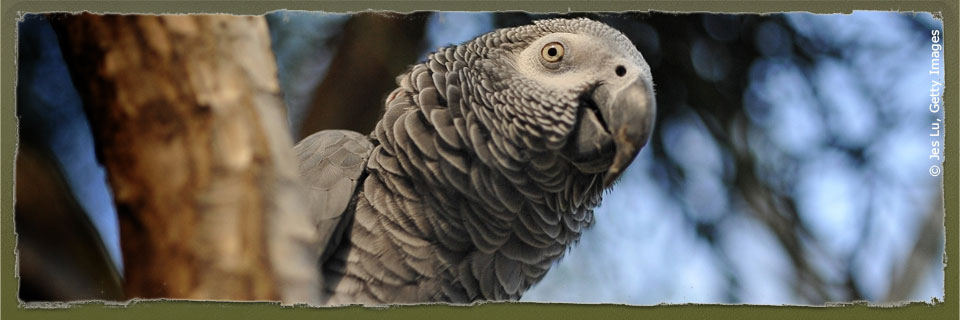
Dear Janice, This is a good question and one we've puzzled over for the last few years. You may recall that we ran a short piece on this in the PsittaScene with some grisly pictures of grey parrot heads and tails which were apparently being traded for sale. Clearly there has been at least one incident of this type in Cameroon, and at the time, the suggestion was that the parts were being sold in Nigeria.
filed under: Conservation
Answered by Jamie Gilardi:
Dear Daria, Interesting question indeed! While we don’t advocate for the promotion of non-native species, especially non-threatened species well outside their historic range, we can provide a bit of background as most of this information is readily available on the web and in published papers and books.filed under: Conservation
Answered by WPT Administrator:
Hi Rachel, thank you for your great question! We've asked Birds Australia to comment, as they have has an ongoing conservation program for the birds for many years. Here is the reply we received from Cheryl Gole, Manager, Important Bird Areas Project - Birds Australiafiled under: Conservation
Answered by Jamie Gilardi:
Dear Dot, I believe that would be three questions - actually four because the first is really two bundled togetherfiled under: Conservation
Answered by Jamie Gilardi:
filed under: Conservation
Answered by Jamie Gilardi:
Dear Cindi,
Great question! We were thrilled with the initial donation and the fact that it inspired so many people to contribute, effectively doubling the outcome.
And yes, by all means, simply contact us at any of our branches by either email or telephone and we’ll work with you on how best to proceed. To set up a matching campaign like this requires a bit of work, so it really only makes sense when the added value more than compensates for the staff time required to set it all up and to get the word out. One thing that works very well is for supporters to talk to their good friends who care about nature conservation in general, to see if they can make the initial pledge more significant from the get go. There are few things more convincing than someone making a compelling case for something and for them to be putting their own funds forward to support the cause in question. So the idea my be that you can grow your initial sum by several fold, then take that sum and use it to catalyze a matching funds campaign.
Please let us know if we can help with more details or suggestions along these lines, and thank you for your enthusiastic support!
All best wishes,
Jamie
filed under: Conservation
Answered by Jamie Gilardi:
Dear Sandra,filed under: Conservation
Answered by Jamie Gilardi:
Hi Bart, Most of the Blue-headed Macaws in captivity outside of South America are to the best of my knowledge, in Europe. Only a small number are here in the USA, and I think you can still see them on exhibit at the Houston Zoo.filed under: Conservation
Answered by Jamie Gilardi:
Dear Sandra,filed under: Conservation
Answered by Jamie Gilardi:
It really sounds like your bird has a LOT of potential companions already, but back to that in a minute. I suspect what you're really wondering is whether there is a sound conservation justification for breeding your female cockatoo because this species is quite rare in the wild (recall that CITES status isn't specifically about rareness, rather the potential or real threat from trade). Given your bird's history of being around other parrots in the west, it would be very difficult for your bird to be paired for conservation breeding strictly from a disease standpoint. Even if your birds are extraordinarily healthy, they clearly have had opportunities to pick up all sorts of things from all over the world - directly or indirectly - and many of these diseases can be hard to detect. As there are some islands in Indonesia with reasonable numbers of these birds, it is unlikely that captive pet birds like yours or their progeny will play a direct role in the recovery of the species in the wild. Clearly, there are a few species of parrots for which every individual is of potential conservation significance, but these are tremendously rare species like Kakapo, Spix's Macaws, and the like.filed under: Conservation
Page 1 of 1 pages