



Project Regions:
Black-cheeked Lovebird |
|
|
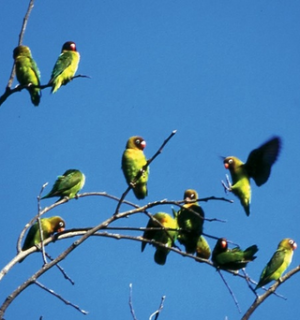
© Louise Warburton, University of Natal
Project Status: Active | 1995 - 2004, 2021- current
Collaborators/Funders
The University of Natal, The Foundation for Research and Development (RSA), the Wildlife Conservation Society (USA), the Zambezi Society (UK), the Canadian World Parrot Trust, the German Zoological Society for the Conservation of Species and Populations, the International Fund for Animal Welfare Charitable Trust (UK), The British Ornithological Union (UK), The Lovebird (1990) Society (UK), The Parrot Society (UK) and The Conservation in Aviculture Society (UK). British Airways Assisting Conservation, BirdWatch Zambia, the Wildlife and Environment Society of Malawi, African Parks, the Malawi University of Science and Technology and Zambia Wildlife Authority, Pamela Isdell, Gesellschaft für Tropenornithologie e. V., Swissline cosmetics, International Foundation for Science and BirdLife International/Good Gifts catalogue, African Bird Club.
Black-cheeked Lovebird population numbers have severely declined since the 1920s. The WPT is working to help protect and boost their remaining numbers.
Black-cheeked Lovebirds live in a highly restricted range. They are affected by trapping for the wildlife trade, persecution and habitat loss through drought and changing agricultural practices.
How WPT makes an impact: The World Parrot Trust, along with a number of scientists and conservation groups, has been involved in conservation and research for the Black-cheeked Lovebird. Studies have mapped the distribution of the species, helped to estimate numbers, identified habitat requirements and evaluated threats. Recent work has focused on trialling the use of nest boxes to replace lost nesting trees, carrying out genetic studies to better understand the connections between species and plan for breeding-for-release programs, ongoing monitoring of populations and inspiring local communities to become stewards of these birds through educational programs.
Population: About 10,000
Vital statistics: Size: 13-14 cm (5-5.5 in) Weight: 40g (1.4 oz)
Range: Highly restricted range, from southern Kafue National Park, southwestern Zambia along Zambesi valley to Victoria Falls, Zimbabwe.
Natural history: This species is found in mopane and Acacia woodland; also occurs in riparian forests and areas with fig trees. Found at 600-1000m (1968-3280 ft). Birds forage for seeds, including: Amaranthus, Rottboellia exaltata, Rhus quartiniana, Albizia anthelmintica, Combretum massambicense and Syzygium guineense, and grass seeds Hyparrhenia and Eragrostis; also young leaves of Pterocarpus antunesiana, grain, flowers, buds, young leaves and berries. They generally stay near water sources and are found in flocks of a few dozen individuals. Breeding is November-December in Zambia; nest is in large mopane tree.


Programs & Projects